Energy Efficient Cooling Systems: The Smart Way to Stay Cool Without Burning the Planet
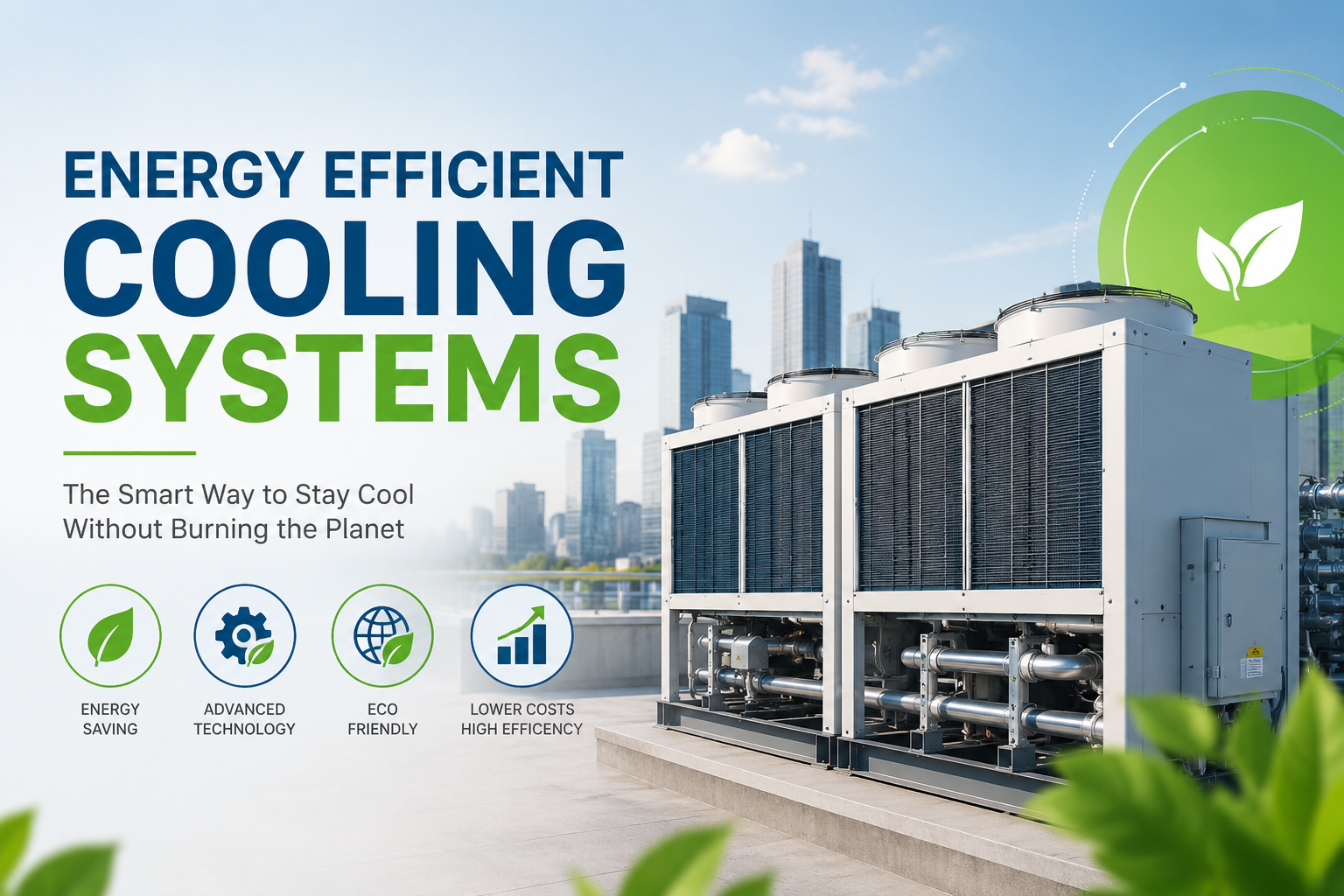
A guide for businesses and facility managers looking to cut energy costs and carbon footprint through modern cooling technology.
As global temperatures rise and energy bills climb higher every year, one question is keeping facility managers, business owners, and sustainability officers up at night: how do we keep our buildings cool without it costing the earth — financially or environmentally?
The answer lies in energy efficient cooling systems. Far from being a niche or experimental technology, today's high-performance cooling solutions are proven, widely adopted, and increasingly essential for any organisation serious about operational efficiency and sustainability goals.
In this article, we'll break down what energy efficient cooling actually means, the key technologies driving the shift, and what to look for when upgrading or specifying a system.
Why Cooling Efficiency Matters More Than Ever
Cooling accounts for roughly 10% of global electricity consumption, according to the International Energy Agency — and that figure is growing. In commercial buildings, HVAC systems (Heating, Ventilation, and Air Conditioning) often represent the single largest slice of the energy bill.
Traditional electric-driven chillers and air conditioning units work hard to keep spaces comfortable, but they are inherently power-hungry. For organisations chasing net-zero targets or simply trying to reduce overheads, inefficient cooling is low-hanging fruit that can no longer be ignored.
Beyond cost, there's the regulatory landscape to consider. With tightening environmental legislation across the UK and Europe, businesses are being pushed — and in some cases mandated — to adopt cleaner, more efficient building systems.
Key Technologies in Energy Efficient Cooling
1. Absorption Chillers
Perhaps the most compelling technology for organisations with access to waste heat or renewable heat sources is the absorption chiller.
Unlike conventional electric chillers that use a compressor driven by electricity, absorption chillers use heat energy — from gas, combined heat and power (CHP) systems, solar thermal, or waste industrial heat — to drive the cooling process. The result is dramatically lower electrical consumption.
Yazaki and World Energy absorption chillers, for example, are designed specifically to harness low-grade heat that would otherwise go to waste, converting it into reliable, high-capacity cooling. For sites already generating heat as a by-product — hospitals, hotels, data centres, and manufacturing facilities — absorption technology offers a near-perfect efficiency loop.
Key benefits:
- Reduced electricity demand (up to 90% less electrical input compared to conventional chillers)
- Lower running costs over the system's lifetime
- Reduced carbon emissions when paired with renewable or waste heat
- Quieter operation and fewer moving parts mean lower maintenance requirements
2. VRV/VRF Air Conditioning Systems
Variable Refrigerant Volume (VRV) and Variable Refrigerant Flow (VRF) systems represent a significant step up from traditional fixed-speed cooling units. These systems adjust the flow of refrigerant to match the precise demand of each zone within a building, rather than running at full power regardless of actual need.
The efficiency gains are substantial. Zones that are unoccupied or require less cooling simply receive less — which means the system as a whole does far less unnecessary work.
For offices, retail spaces, and multi-room commercial environments, VRV/VRF systems offer both comfort and control, often integrating with building management systems (BMS) for centralised energy monitoring.
3. Adiabatic Coolers
Adiabatic coolers offer an energy-efficient alternative to traditional cooling towers and dry coolers. They work by pre-cooling the incoming air using evaporated water before it passes over the heat exchanger — reducing the temperature differential required and significantly cutting energy use during peak summer conditions.
Compared to wet cooling towers, adiabatic coolers use considerably less water, require fewer chemical treatments, and present a lower Legionella risk — making them attractive from both an operational and compliance standpoint.
For process cooling, data centres, and industrial applications where reliable heat rejection is critical, adiabatic coolers strike an excellent balance between performance and efficiency.
4. Heat Pumps and Ground Source Systems
Air-source and ground-source heat pumps can provide both heating and cooling from a single system, making them one of the most versatile tools in modern building energy management. Ground source heat pumps (GSHP), in particular, achieve remarkable efficiencies by leveraging the stable underground temperature as either a heat sink (in cooling mode) or a heat source (in heating mode).
While the upfront installation costs are higher, the long-term energy savings and eligibility for government incentive schemes make heat pumps an increasingly attractive investment for new builds and major refurbishments.
What to Look for When Specifying an Efficient Cooling System
Choosing the right solution isn't just about picking the most efficient unit on paper. Real-world efficiency depends on several factors:
- System sizing: An oversized or undersized unit will run inefficiently. A proper heat load calculation is essential before specifying any system.
- Coefficient of Performance (COP) and Energy Efficiency Ratio (EER): These metrics tell you how much cooling output you get per unit of energy input. Higher is better — look for systems with strong seasonal performance ratings (SCOP/SEER) that reflect real operating conditions.
- Integration with existing infrastructure: Can the system use existing pipework, electrical infrastructure, or waste heat sources? The less you need to build from scratch, the better the return on investment.
- Maintenance requirements: A highly efficient system that isn't maintained properly quickly reverts to being an inefficient one. Look for suppliers that offer planned preventative maintenance contracts to keep systems performing at specification.
- Environmental credentials: Check refrigerant types — lower Global Warming Potential (GWP) refrigerants are not just better for the environment, they are increasingly required by legislation.
The Business Case: Efficiency Is an Investment, Not a Cost
One of the most persistent misconceptions about energy efficient cooling is that it carries a prohibitive price premium. In reality, when you account for:
- Reduced energy bills over the system's operational life
- Lower maintenance costs (particularly for absorption and adiabatic systems with fewer mechanical components)
- Potential government incentives and carbon credits
- Future-proofing against rising energy costs and tighter regulations
...the business case for upgrading to an efficient system becomes compelling, often with payback periods of three to seven years on commercial installations.
For organisations not ready to commit to full ownership, rental options for temporary or bridging cooling capacity provide access to high-efficiency equipment without capital outlay — useful during refurbishments, peak demand periods, or while permanent systems are being specified.
Final Thoughts
The shift to energy efficient cooling is not a trend — it is the direction of travel for every sector that takes operational cost and environmental responsibility seriously. Whether it's an absorption chiller leveraging waste heat on a hospital campus, a VRF system giving precise control across a busy office floor, or an adiabatic cooler quietly handling process heat on an industrial site, the technologies are mature, proven, and increasingly accessible.
The question is no longer whether to invest in efficient cooling, but which system is right for your building, your heat profile, and your sustainability ambitions.
Working with an experienced HVAC specialist — one who understands both the technology and the specific demands of your sector — makes all the difference between a system that delivers on paper and one that delivers in practice.
BDS Energy specialises in sustainable HVAC and absorption cooling solutions for the commercial and industrial sectors across the UK. From Yazaki absorption chillers to adiabatic coolers and full planned maintenance services, BDS helps organisations reduce their energy consumption and carbon footprint without compromising on comfort or reliability.
To find out more or request a consultation, visit www.bds-energy.com or call +44 (0) 121 796 6451.